
Category Archives: Positive Risk-Taking

Do what you say on your tin

Canadian Falls 3Are you taking the risk? It is something we all do, but why do we confuse and complicate it by our lackadaisical use of language? We take risks in order to gain something for ourselves, and occasionally others. We weigh up the options available to us, and make a decision based on what we compute to be the most beneficial course of action. It is called positive risk-taking not because we are trying to find a ‘positive risk’ (whatever that is), but because we are taking the risk in order to achieve a positive outcome (the gain or benefit). So, the word positive is about the outcome not about the risk! I am also not talking about ‘positive risk management’, which sounds too general and like unnecessary window-dressing of a process more often seen as negative or risk-averse. The word positive is being added to risk-taking, in my context, in order to bring some clarity and specific detail to your thinking.

We revere risk-takers in the worlds of sport, entertainment and business, tending to attribute degrees of awe to their decision-making and achievements. Do you think Ayrton Senna planned his route, speed and overtaking manoeuvres around the race-track because he thought the risk would be nice? Does Warren Buffett make his financial decisions based on a spin of his favourite coin? It is more than likely that both of these people employed complex ways of weighing up the pros and cons of choices facing them, sometimes with careful thought and consideration, and sometimes distilling a lifetime of experience into a split second. So do we, in our own personal circumstances.
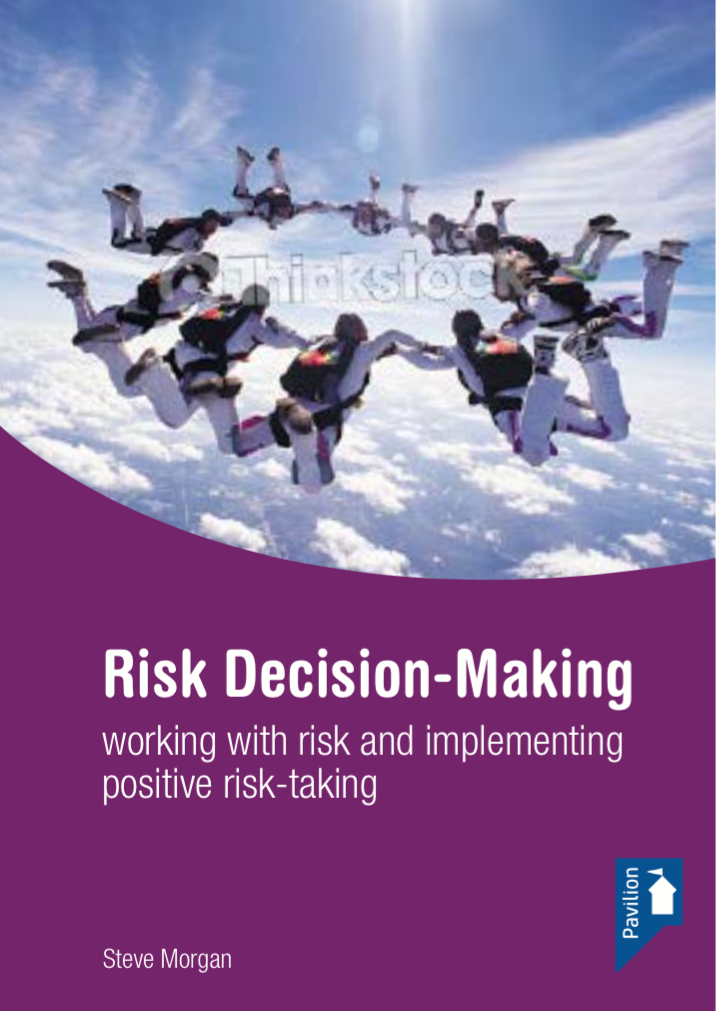
Risk Decision-MakingSo, next time you are leaning on a bar deciding whether to have that extra Babycham, remember that positive risk-taking is weighing up the pros and cons of your particular set of circumstances at that time. Whereas the positive risk is simply the chance that they might taste better the more you have; and the positive risk management is the hope that those around you will help you home instead of tying you to a lamp-post at the end of the night. These concepts mean different things, so be clear when you use language, only positive risk-taking is thoughtful and considered. But… what do you think?

http://www.pavpub.com/risk-decision-making/

“Words are how people think. When you misuse words, you diminish your ability to think clearly and truthfully.” [Margaret Heffernan].
Podcast Episode 043: Suicide Risk [2]

IMAG1511What role does positive risk-taking have to play when someone is experiencing and expressing serious suicidal thoughts? Firstly, we have a duty to take such expressions very seriously, but the language of suicide risk can often appear overwhelming to others, and generate great fears of what might be.

Do we respond in a way that manages the other person, manages the situation, and ultimately takes over through assuming control over and for the person? Do we really take that step backwards, and give ourselves whatever time is available to listen to the person and help them explore their options in a supported relationship? We cannot eliminate risk, but do we become overwhelmed by a fear of engaging in the real conversation?

There is no such thing as a risk-free option, and in this episode I outline a case example from my own practice that illustrates how positive risk-taking was put in place through listening and acting on what the individual has to say, identifying alternatives, and exploring strengths and potential protective factors alongside the serious expression of risk.

For the full content of this episode click on the links for iTunes and Sound Cloud (or go to Stitcher Radio):

https://itunes.apple.com/gb/podcast/strengths-revolution-steve/id867043694

https://itunes.apple.com/gb/podcast/043-suicide-risk-2/id867043694?i=333467695&mt=2

“If it wasn’t for the possibility of suicide I would have killed myself a long time ago.” [Unknown source].

Podcast Episode 042: Suicide Risk (Interview case example)

TheStrengthsRevolution_albumart_2-2This episode is an interview with Satsanga (Lawrence Borish) reflecting on a case example of Alice, who he worked with whilst on a family counselling placement in his Masters Degree Social Work training in the US back in 1968. The placement was focused on cultural awareness, and the specific referral emerged through neighbourly concern for a woman whose behaviour and appearance was deteriorating. However, on engaging Alice, Satsanga discusses how, as a young inexperienced social worker, he is suddenly presented with an expression of suicidal ideas.

How we respond to these immediate circumstances can have a heavy bearing on the future life of another person. The interview explores issues of engagement of trusting working relationships, working with instinct, exploration of genuine alternatives to suicide, genuine collaboration between a person and a worker… all of which are important components of the process of ‘positive risk-taking’. The discussion raises thoughts about how we are supported, or not, to make difficult decisions; and could a decision-making process from a bygone era remain relevant today?

For the full content of this episode click on iTunes or Sound Cloud (or go to Stitcher Radio):

https://itunes.apple.com/gb/podcast/strengths-revolution-steve/id867043694

https://itunes.apple.com/gb/podcast/042-suicide-risk/id867043694?i=331833222&mt=2

Dementia and Positive Risk-Taking

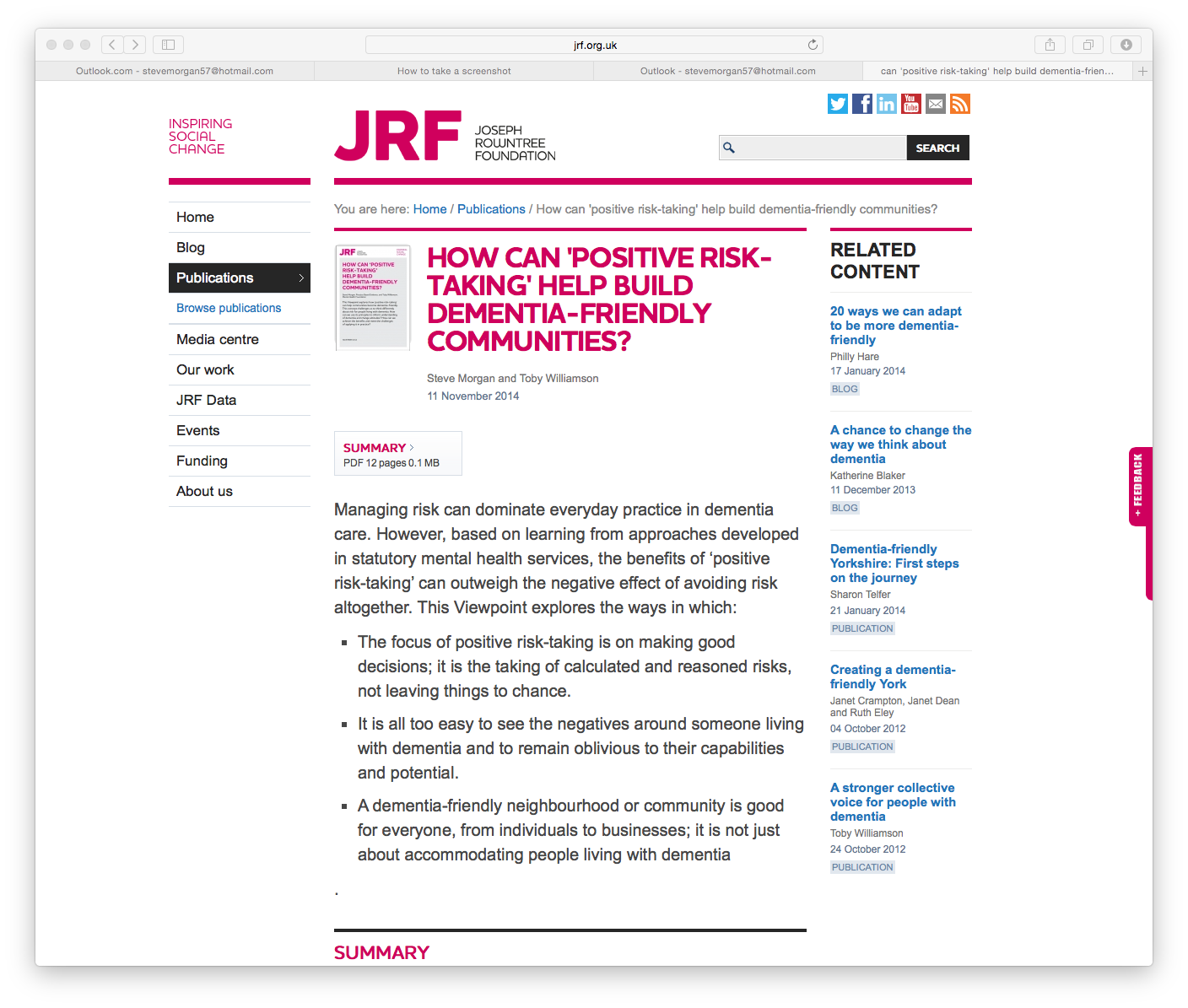
JRF screenshotSteve Morgan (Practice Based Evidence) and Toby Williamson (Mental Health Foundation) were commissioned by the Joseph Rowntree Foundation to produce a ‘Viewpoint’ think piece for their published series of thought-provoking topics. The focus was to apply the concept of ‘Positive Risk-Taking’ (developed from 1994 by Steve Morgan) to the relatively new UK government initiative of ‘Dementia-friendly Communities’.

Check out the following link for the full publication, which sets out an explanation of ‘Positive Risk-Taking’, ‘Dementia-Friendly Communities’, and the benefit of taking risks to support people to live with dementia better:

http://www.jrf.org.uk/publications/how-can-positive-risk-taking-help-build-dementia-friendly-communities


Podcast Episode 034: Planning your business Part 2

TheStrengthsRevolution_albumart_2-2Putting together a business plan is vitally important but requires some caution. We are reminded that the realities of life happen to us while we are busy making other plans.

For all the well thought out plans we still need to respond to events and circumstances. This episode explores five reasons why we should be cautious about the amount of time invested in planning, as well as the danger of becoming rigidly attached to our plans. Steve Morgan uses his own experiences through the Practice Based Evidence Consultancy in response to each of the points of caution.

For the full content of this episode click on the links to iTunes and Sound Cloud (or go to Stitcher Radio):

https://itunes.apple.com/gb/podcast/strengths-revolution-steve/id867043694

https://itunes.apple.com/gb/podcast/034-planning-your-business/id867043694?i=326162015&mt=2

“There is nothing more frightful than ignorance in action.” [Goethe].


Podcast Episode 033: Planning your business Part 1

TheStrengthsRevolution_albumart_2-2Whatever your career or business that you are involved in, you may engage in degrees of forward planning. So why put together a business plan? Whether you are ‘planning’ (i.e. the vision thing) or making plans (i.e. the detail thing), there are a number of good reasons to have a plan for your business or career in place, and also to keep reviewing that plan.

This episode sets out 6 reasons in favour of degrees of planning, and uses the presenter’s own personal experience in moving from employment in a national organisation to going it alone in self-employment as a case study to illustrate the reasons. The episode finishes with a message of caution through a reality check, life may rarely mirror your plans.

For the full content of this episode click on the links to iTunes or Sound Cloud (or go to Stitcher Radio):

https://itunes.apple.com/gb/podcast/strengths-revolution-steve/id867043694

https://itunes.apple.com/gb/podcast/033-planning-your-business/id867043694?i=324631141&mt=2

“In preparing for battle I have always found that plans are useless, but planning is indispensable.” [Dwight D. Eisenhower].

Podcast Episode 021: Strengths & Decision-Making

TheStrengthsRevolution_albumart_2-2How do we go about making decisions? The answer partly depends on the situations or circumstances we are in… ‘situational decision-making’ is an assessment of the situation followed by a quick mental simulation of the likely outcome of our chosen course of action. It is based in experience, responds to pressures on available time, and helps us manage ambiguous detail. It is a partly intuitively based approach to decision-making.

Alternatively, ‘analytical decision-making’ is a more structured approach applied to research, clinical and other work situations where masses of abstract data need processing, or a range of different people come together to make a decision.

Ultimately it is not so much about finding the right or wrong decision, but more about our ‘confidence’ in the decisions we have made. Confidence will be underpinned by a focus on the strengths that can be identified and productively applied as a crucial component in our approach to making decisions. An absence of identified strengths can still offer confidence, but in these circumstances it will be confidence in making the more risk averse decisions.

For the full content of this episode click on the links to iTunes and Sound Cloud (or go to Stitcher Radio):

https://itunes.apple.com/gb/podcast/strengths-revolution-steve/id867043694

https://itunes.apple.com/gb/podcast/021-strengths-decision-making/id867043694?i=318067222&mt=2

“When possible make the decisions now, even if action is in the future. A reviewed decision usually is better than one reached at the last moment.” [William B Given].


Podcast Episode 020: Confidence Tricks [2]

TheStrengthsRevolution_albumart_2-2Positive risk-taking and risk decision-making are challenges that can be achieved with greater confidence if the right conditions are in place. For practitioners in health and social care services, and for others beyond these services, a number of factors can influence your degree of confidence in your decision-making.

Being genuinely person-centred, as we are always dealing with an individual with their unique combination of strengths alongside the problems and risks. Good team-working, and support and supervision, can greatly influence the quality of decisions influenced through the culture of the team or service. The issue of ‘culture’ should also extend to the wider organisation, through the understanding of positive risk-taking and processes of risk decision-making, and supporting people’s decisions irrespective of the outcome if they have followed reasonable guidelines of good practice.

Accessing appropriate tools to guide and influence decision-making, as well as prioritising the time needed for those more complex and challenging decisions.

For the full content of this episode click on the links to iTunes and Sound Cloud (or go to Stitcher Radio):

https://itunes.apple.com/gb/podcast/strengths-revolution-steve/id867043694

https://itunes.apple.com/gb/podcast/020-confidence-tricks-2/id867043694?i=317753484&mt=2

“When you train your employees to be risk averse, then you’re preparing your whole company to be reward challenged.” [Morgan Spurlock].

Podcast Episode 019: Confidence Tricks [1]

TheStrengthsRevolution_albumart_2-2Risk-taking is part of a healthy way of living, and we make decisions every day. However, just occasionally we are confronted with potential life-changing decisions, such as changing a job, moving our home, expressing feelings for others, marriage, children, divorce, and end of life choices.

How can we face some of these major decisions and make them with greater degrees of confidence? This episode offers a number of common sense tips to help us develop that confidence. Being reflective, checking things out with trusted friends, being aware of consequences, being open to learning not just seeing things as simple as success or failure.

Fir the full content of this episode click on the links to iTunes and Sound Cloud (or go to Stitcher Radio):

https://itunes.apple.com/gb/podcast/strengths-revolution-steve/id867043694

https://itunes.apple.com/gb/podcast/019-confidence-tricks-1/id867043694?i=317489992&mt=2

“But he learned long ago that a life lived without risks pretty much wasn’t worth living. Life rewarded courage, even when that first step was taken neck-deep in fear.” [Tamera Alexander].

Podcast Episode 016: Risk Taking v Risk Aversion

TheStrengthsRevolution_albumart_2-2Are we risk takers or are we generally more conservative in our risk decision making, more risk averse? There is no blanket answer to this question for any of us, as there are different situations and circumstances that influence us in different ways.

Health and Social Care service practitioners may become more risk averse in particular situations, and some will be more risk averse depending on their own experiences. When is it ok to be risk averse? When it is the clearly reasoned decision based on careful consideration of the information available to us.

Risk decisions will be part of everyday experiences within health and social care services across all sectors e.g. mental health, learning disability or older persons services. The same principles apply to all of us in our personal lives, when we are confronted with situations that require a difficult decision.

For the full content of this episode click on the links to iTunes and Sound Cloud (or go to Stitcher Radio):

https://itunes.apple.com/gb/podcast/strengths-revolution-steve/id867043694

https://itunes.apple.com/gb/podcast/016-risk-taking-v-risk-aversion/id867043694?i=316511320&mt=2

“There is a short window at the beginning of one’s professional life when it is comparatively easy to take big risks. Make the most of that time, before circumstances make you risk averse.” [Joshua Foer].