Tag Archives: Positive risk-taking

Collaborative risk decisions

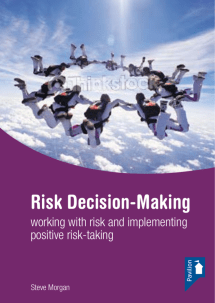
Risk Decision-Making

Risk decisions are frequently challenging situations to us individually. A risk averse stance can be expected, not least out of the thoughts for self preservation. Collaborative decision-making provides the foundation for increased information, collective reflection, and confidence through shared accountability.

Use the following link to also access a free training webinar which introduces my simple 5-step process to risk decision-making, which also form the core modules of the Positive Risk-Taking Membership Site:

https://app.webinarjam.net/register/21360/99e6026a97


Introducing a Strengths & Risk Relationship

Working-with-Strengths

Risk assessment is inherently negative in the information it provides, naturally driving us to be more restrictive or risk averse. It is strengths information that will provide the basis for confidence in order to move forward in taking appropriate risks.

Use the following link to also access a free training webinar which introduces my simple 5-step process to risk decision-making, which also form the core modules of the Positive Risk-Taking Membership Site:

https://app.webinarjam.net/register/21360/99e6026a97

Risk: the bureaucracy v practice conundrum

WWR 2007
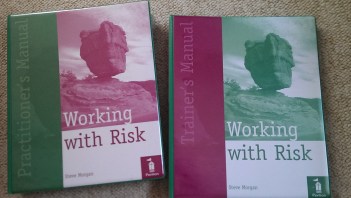
Working with Risk (2007)

Reflecting on questions regarding the purpose and design of risk paperwork, and the role of evidence in its construction.

Use the following link to also access a free training webinar which introduces my simple 5-step process to risk decision-making, which also form the core modules of the Positive Risk-Taking Membership Site:

https://app.webinarjam.net/register/21360/99e6026a97

A Focus on Risk Training

Risk Decision-Making    Working with risk and making risk decisions is an essential part of the work of any practitioner in health and social care settings. But, is our risk training really fit for purpose in many organisations? The following short video sets out the case for a training strategy focused more on teams, in order to be a more effective use of time and resources.


Use the following link to also access a free training webinar which introduces my simple 5-step process to risk decision-making, which also form the core modules of the Positive Risk-Taking Membership Site:

https://app.webinarjam.net/register/21360/99e6026a97


Taking risks for positive outcomes

Positive Risk-Taking logoThe following short video is a message focusing on a main theme presented in my Positive Risk-Taking Membership Site.

Use the following link to access a free training webinar which introduces my simple 5-step process to risk decision-making, which also form the core modules of the Positive Risk-Taking Membership Site:

https://app.webinarjam.net/register/21360/99e6026a97

Risk Aversion or Risk-Taking?

Positive Risk-Taking logo

We all work with risk; we all have to make risk decisions, and sometimes those decisions involve the challenge of taking risks. Part of overcoming the challenges resides in our awareness of our own mindset in relation to risk. I have a simple 5-step approach to helping me make the challenging decisions… in work as well as in life.

Click on the following link to access a free webinar that provides 40+ minutes of training in the challenges risk can present, and an introduction to my 5-step approach:

https://app.webinarjam.net/register/21360/99e6026a97

This webinar condenses 30+ years of my experience working in and alongside health and social care services, and 60+ publications around the subject. Risk is something we should embrace from a positive perspective, and this webinar develops this mindset.

Positive Risk-Taking & Dementia-Friendly Communities

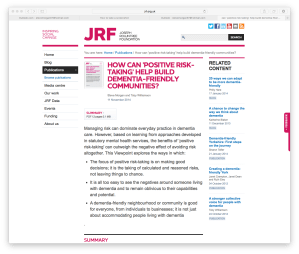
JRF screenshotThe increasing incidence of dementia, and profile it is gaining in the public imagination, means that this is a condition that none of us can ignore. What role might a strengths approach have to play in the way we view people living with dementia? It is all too easy to see the negatives and deficits around someone living with dementia, and to remain oblivious to their capabilities and potential, as well as the supportive resources they have around them. Just because you have a particular label doesn’t mean you have lost all capacity to dream and desire a reasonable quality of life for yourself, as determined by you, not imposed on you by others. However, the so-called ‘community’ can become a progressively challenging place as cognitive capabilities decline.

‘Positive risk-taking’ is a concept well established by the Practice Based Evidence consultancy, and it applies equally to the risks a person living with dementia may wish to take, and to all of us who live in, work in and develop communities. The Joseph Rowntree Foundation commissioned a piece of work from a collaboration of Practice Based Evidence and the Mental Health Foundation to investigate how the concept of positive risk-taking may apply to the government initiative of developing dementia-friendly communities. The think piece is explored in the published ‘Viewpoint’ at the following link:

http://www.jrf.org.uk/publications/how-can-positive-risk-taking-help-build-dementia-friendly-communities

“Those with dementia are still people and they still have stories and they still have character and they’re all individuals and they’re all unique. And they just need to be interacted with on a human level.” [Carey Mulligan].

Check out ‘Still Alice’ as a great portrayal of the tragic descent into dementia, and the impact on a wider family as well as the person living with the condition.


Podcast Episode 091: Positive Risk-Taking in practice

TheStrengthsRevolution_albumart_2-2It’s one thing to have a great idea but another entirely to put it successfully into practice, particularly if it is about delivering on difficult and challenging decisions. What does it take to put positive risk-taking into practice with clarity and confidence?

This was a concept I developed in 1994 and have been refining and implementing with so many people in the intervening years. Everyone wants to feel like they do good risk-taking practice, but when examined closely there are a plethora of obstacles to be overcome in the process.

In this episode I outline a list of 14 essential ingredients for putting positive risk-taking into practice. A combination of shared understanding by individuals, teams and organisation management is a good starting point; but that is often difficult enough to achieve. I outline the value of strengths-based practice for underpinning good risk-taking decisions, as well as consensus in teams, adequate training, supervision and support, and the application of checklists and tools I designed specifically for the purpose.

For the full content of this episode click on the links to iTunes and Sound Cloud (or go to Stitcher Radio):

https://itunes.apple.com/gb/podcast/strengths-revolution-steve/id867043694

https://itunes.apple.com/gb/podcast/091-positive-risk-taking-in/id867043694?i=359052989&mt=2

“If you do what you’ve always done, you’ll get what you’ve always gotten.” [Tony Robbins].

“Life is inherently risky. There is only one big risk you should avoid at all costs, and that is the risk of doing nothing.” [Denis Waitley].

Podcast Episode 090: Implementing great work

TheStrengthsRevolution_albumart_2-2A good idea is about 10 percent of the effort, it’s the implementation and hard work that makes up the bulk of the effort. But how do we go about identifying and implementing good ideas? What can we use to help us deliver great work?

In the case of a Strengths Approach and Positive Risk-Taking, two of my signature ways of working, I have developed specific practice development tools to help not just identify the ideas but just as importantly put them into practice.

In this episode I outline the Practice Based Evidence evaluation and implementation tools I use in my team development work to put these two particular concepts into practice. These are practice-based tools to be owned and used by frontline staff and teams; these are definitely not managerial tools with a top-down need to audit. There comes a moment when you need to stop revving up the car and shove it into gear (David Maloney), and these tools are part of the gear mechanism not the braking system!

For the full content of this episode click on the links to iTunes and Sound Cloud (or go to Stitcher Radio):

https://itunes.apple.com/gb/podcast/strengths-revolution-steve/id867043694

https://itunes.apple.com/gb/podcast/090-implementing-great-work/id867043694?i=359052990&mt=2

“When you translate a dream into reality, it’s never a full implementation. It is easier to dream than to do.” [Shai Agassi].

“Success seems to be connected with action. Successful people keep moving. They make mistakes, but they don’t quit.” [Conrad Hilton].

Assertive Outreach: Examples of Great Teams

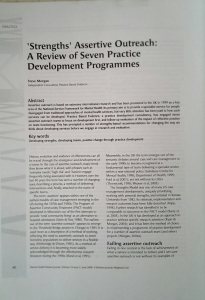
IMAG2227_1‘Strengths’ Assertive Outreach: A Review of Seven Practice Development Programmes.

The Practice Based Evidence consultancy made special efforts to get involved in going beyond simple training; focusing on developing teams with a positive impact on practice. It is one thing to claim to support best practice, but another thing entirely to provide evidence for such claims. Assertive Outreach teams in the UK were a particular passion from the original establishment of the consultancy in October 2001. The following article was first published in the Mental Health Review Journal (June 2008) and is reproduced with their kind permission; it is an evaluation of the support provided, from a strengths perspective, for seven such teams.

ABSTRACT

Assertive outreach is based on extensive international research and has been promoted in the UK in 1999 as a key area of the National Service Framework for Mental Health. Its primary aim is to provide a specialist service for people disengaged from traditional approaches of mental health services, but very little attention has been paid to how such services can be developed. Practice Based Evidence, a practice development consultancy, has engaged seven assertive outreach teams to focus on development first, and follow-up evaluation of the impact of reflective practice on team functioning. This has prompted a number of strengths-based recommendations for changing the way we think about developing services before we engage in research and evaluation.

PDF: ‘Strengths’ Assertive Outreach: A Review of Seven Practice Development Programmes