Occupational Therapist since 1986, Case Manager since 1990, Author since 1993, Consultancy since 2001. Launched a blog from 2013, a podcast in 2014, and YouTube videos from 2017.
Open Mind was a fabulous social care focused magazine for which I published a number of articles between 2000-2012. The following article was first published in OpenMind 126, Mar/Apr 2004) and was reproduced with their kind permission on my website at Practice Based Evidence.
It remains just as pertinent to practice today as it ever was, so I provide the link here to the strengths-based article. It focuses on the importance of principles, and the need to change the focus of our language in health and social care services to ‘go beyond the alphabet of negativity’…
In this episode Steve Morgan reflects on the brief life of his cat, Juno, and the strength we derive from our pets, not just what we offer to them.
Juno’s sudden and unexpected death prompts reflection not just on the life she brought to Steve’s home; no, this was a cat that provided the inspiration for a blog… Juno’s View at http://cardiffcoolcat.com/ offering a creative option as to how to view a local city. All pet owners and lovers are challenged to take a long look at your pet(s) and identify the source of strength they provide for you.
For the full content of this episode click on the links to iTunes or Sound Cloud (or go to Stitcher Radio):
As 2014 draws to a close, and many of you take stock and use a little time to reflect, it is important to celebrate your achievements. For me, this blog and podcast show has been a pure joy to initiate and develop. However, it is underpinned by consistent strengths-based thinking, and I was particularly pleased to be able to publish ‘Working with Strengths…’ this year.
Why listen to the self-styled publicity of the author when you can take the word of an independent expert? The following are extracts from the Foreword written by my very gracious friend Professor Steve Onyett:
Radical in the sense of challenging the status quo. I love the notion of “funky” mental health services where we first break all the rules – not in a spirit of anarchy so much as in recognition of the fact that so many of our current assumptions simply don’t serve. We need more sacred fools who will run into the royal court and fart in front of the King or Queen in order to shake things up and reveal new and better ways.
There is no shortage of guidance around. There is a plethora of exhortations to be positive and focus on strengths from every direction. However, not so many get behind the rhetoric to look with clear and open eyes at how this plays out in reality. This requires that we look not just at what people say they do, but what they do do. It means that we need to look at what happens in practice and learn from that experience.
Steve Morgan is one of our greatest assets in this context. He has been at the forefront of the movement for strengths based practice in mental health services for a long time and has borne witness to both its successes and it’s disappointments. He has brought this invaluable perspective to bear here in a book that tells you pretty much everything there is to know about how things could be, while also equipping you for the stark realities of implementation in challenging contexts. He does this without judgement or cynicism, thereby leaving us with a sense of the possible and a range of first steps that we can take to make it happen. It has been said that a cynic is a passionate person that does not want to be disappointed again (Zander and Zander, 2000). Here Steve talks to the passion rather than the disappointment.
The turn of the year is the time when many people set the resolutions, that quickly become forgotten, or are a repeat of the ones set previous years. This is not the best way to make meaningful changes in your personal or business life.
Planning and goal-setting can be an invaluable component of successful change and sustaining achievements, but it requires thought and focus if it is to be followed through with any genuine intent. As an example of an excellent process for goal planning Michael Hyatt has an influential programme ‘5 days to your best year ever’, but this type of process doesn’t always have to apply to the turn of the year.
In this episode I outline a 5-stage process to setting those SMART goals, from personal belief and reflection through to specific goals, actions and the all-important need to review… keep on your own case if you want to make best use of the idea of planning and goal-setting. This episode asks you to focus goals broadly across your life, so they need to be personal as well as business oriented.
At a strategic level we are continually expanding the language, but essentially using new words and phrases to say the same thing… recovery, personalisation, self-directed support, person-centred planning, re-ablement/re-enablement. Nobody can seriously disagree with the premise that service users should be given a voice in order to say what they need and want, to reflect on how best to meet their wishes and aspirations, to exercise choice and feel supported in their decision-making. However, there is often a gap between what we are saying we are doing as services, and what service users are experiencing on the receiving end. The distance between strategic vision and practical reality rarely conforms to anyone’s idea of close proximity.
This is where the Strengths Approach or Working with Strengths come into their own… call it what you will, but we need some way of translating the big picture into something that is clearly understood and able to be delivered by workers with service users (and carers). We can talk about journeys all day long, but unless you can walk it unaided then we need a vehicle, a route map, a travel guide or companion… a means of travelling that journey. The Strengths Approach sets out a clear statement of values and principles to guide and support good practice; it provides fit-for-purpose tools and the necessary guidance on flexible use of such tools; and it sets out practice-based policy statements that help to tie-in the organisation – team – practitioner levels to an agreement on what we are doing to support people to experience the rhetoric of person-centred services in reality.
Check out my 2014 publication ‘Working with Strengths…’ for the full story, complete with ideas and tools to support the implementation of best practice.
Steve Morgan in conversation with Kirt Hunte about what contributes to good team-working. We frequently make a claim to be a team but function more as a group of individuals.
What influence does the team manager or team leader have on the identity and function of the team? Can a talented group of individuals simply come together as a great team? Does the size of the team have any affect on its ability to function as a team?
The creativity and risk-taking required for developing a new initiative is very different from the long term sustainability of an established team or service. Kirt and Steve reflect on football teams and mental health teams through their observations and experiences over many years. Reference is also made to the book entitled ‘Organizing Genius’ by Warren Bennis and Patricia Biederman describing and analysing seven case studies of great teams.
For the full content of this episode click on the links to iTunes and Sound Cloud (or go to Stitcher Radio):
Good teamworking, as with so many things, is easily stated and claimed, but not always so easily evidenced. Bringing people together under the name of a specific ‘team’ doesn’t necessarily mean that they function as a true team.
From a strengths perspective, Steve Morgan offers a taxonomy of strengths focused teams… looking at three different levels in relation to the degree of strengths thinking and working that are incorporated into routine teamworking. He further develops the analysis of teamworking through outlining six principles of strengths-based teams… adapted from the original strengths principles focused on how we work with service users or clients.
It is recognised that in any given team there will be individuals who function at different levels in relation to strengths-based principles and practice; however, the extensive Gallup organisation research invites us to improve our overall effectiveness and value by focusing more in a strengths way of working.
For the full content of this episode click on the links to iTunes and Sound Cloud (or go to Stitcher Radio):
What makes a great team? A great leader? Talented individuals? A clear purpose? All of the above and more. This episode helps to define what we mean by ‘team’, as most of us function within a range of different types of teams… sports, management, service provision or focused task or product, all require good team-working. However, teamwork is often easier to talk about than to deliver.
In this episode Steve Morgan focuses on an influential book on his team development work, written by Warren Bennis and Patricia Biederman ‘Organising Genius: The Secrets of Creative Collaboration’. A combination of great leadership and talented individuals are required, but the great groups studied in this seminal publication help to identify fifteen components of what contribute to the development of ‘great groups’. In connection with previous episodes, it is also important to recognise that interfering bureaucracy is entirely absent from the works of the historic great groups!
For the full content of this episode click on the links to iTunes and Sound Cloud (or go to Stitcher Radio):
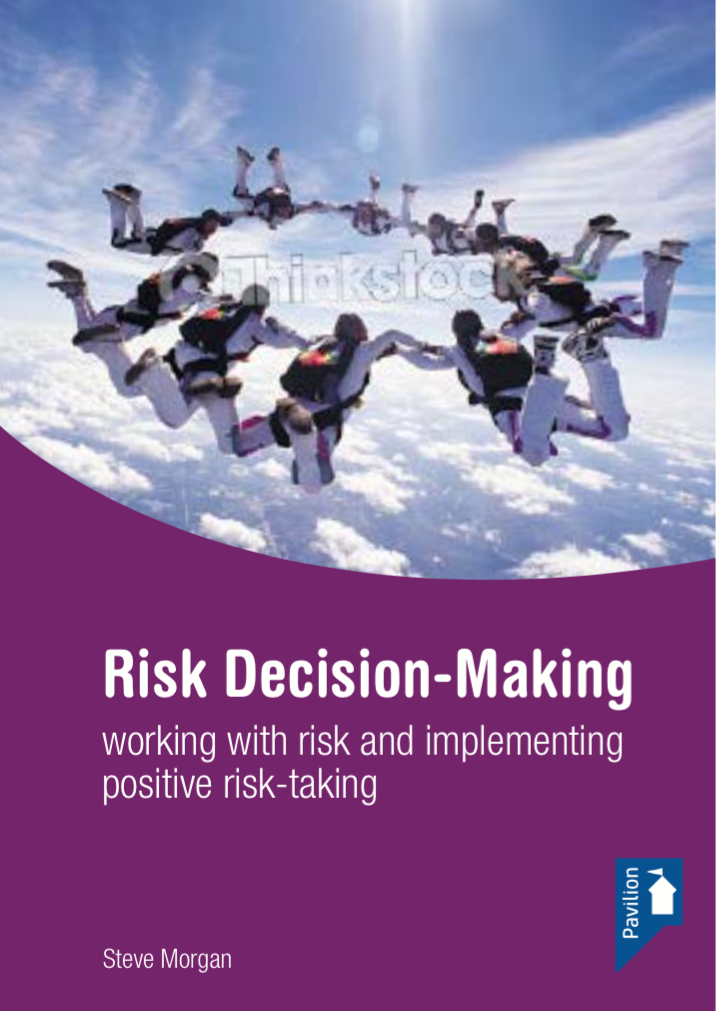
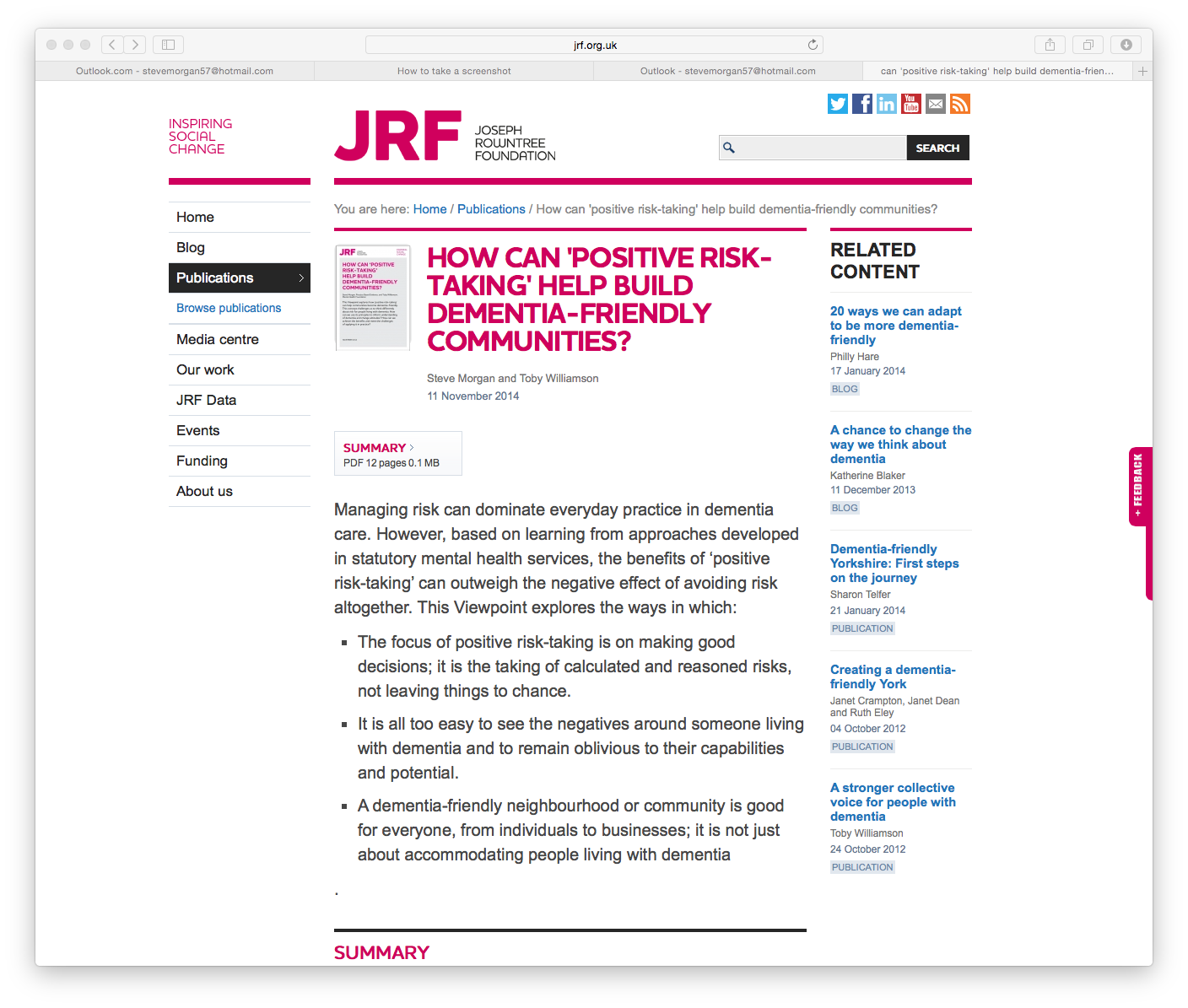
Steve Morgan (Practice Based Evidence) and Toby Williamson (Mental Health Foundation) were commissioned by the Joseph Rowntree Foundation to produce a ‘Viewpoint’ think piece for their published series of thought-provoking topics. The focus was to apply the concept of ‘Positive Risk-Taking’ (developed from 1994 by Steve Morgan) to the relatively new UK government initiative of ‘Dementia-friendly Communities’.
Check out the following link for the full publication, which sets out an explanation of ‘Positive Risk-Taking’, ‘Dementia-Friendly Communities’, and the benefit of taking risks to support people to live with dementia better:
As western industrialised societies have drifted into a post-industrial service industries world, one thing proliferates more than the most infectious of diseases… bureaucracy! Now anything to do with paper, or its electronic offspring, reigns supreme. Managing, auditing and regulating have become effective barriers to creativity and innovation.
The new mantra is standardisation, systematisation, uniformity and safety… conformity ensures mediocrity will be the outer limits of permitted imagination. Do the children of today dream and aspire to become a bureaucrat when they grow up? Do they loose sleep over the excitement of their first suit and form to fill? Take with a large degree of caution any bureaucrat promising to reduce the plethora of bureaucracy. It is not in their interests to free up other people to exercise their talents, initiative and decision-making skills.
To access the full content of this episode click on the links to iTunes and Sound Cloud (or go to Stitcher Radio):

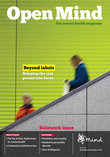 Open Mind was a fabulous social care focused magazine for which I published a number of articles between 2000-2012. The following article was first published in OpenMind 126, Mar/Apr 2004) and was reproduced with their kind permission on my website at Practice Based Evidence.


 The Strengths Revolution