
Tag Archives: Personal development

Podcast Episode 082: Staff Strengths Assessments

TheStrengthsRevolution_albumart_2-2How do we develop the potential of our individual staff members? We are all individual’s with unique abilities, interests, drives and motivations; but do we really spend time identifying and nurturing these?

The Gallup organisation research suggests that the most successful leaders and businesses do, but the majority are still focused more on fixing flaws and weaknesses. A focus on developing and exploiting strengths makes good business sense, so the question is how to go about doing it.

In this episode I outline the structure and approach of the Practice Based Evidence Staff Strengths Assessment tool. Exploring values, collaborations, creativity, team working and knowledge base. This tool has been accepted as an invaluable addition (or even preferred replacement) for traditional organisational appraisal systems. If it’s staff development you genuinely want to achieve this tool will be a valuable addition to any toolkit.

For the full content of this episode click on the links to iTunes & Sound Cloud (or go to Stitcher Radio):

https://itunes.apple.com/gb/podcast/strengths-revolution-steve/id867043694

https://itunes.apple.com/gb/podcast/082-staff-strengths-assessments/id867043694?i=355718153&mt=2

“Success is achieved by developing our strengths, not by eliminating our weaknesses.” [Marilyn dos Savant]
Podcast Episode 081: How to recover our staff

TheStrengthsRevolution_albumart_2-2With all the expectations placed on providing excellent service to clients how can we truly expect staff to value others when they don’t feel valued themselves? So, the concept of a strengths assessment should apply equally to staff members as it does to their work with clients.

In this episode I explore some of the key messages from the wide-ranging Gallup organisation’s strengths research. The focus is on why we should pay more attention to developing individual potentials, and less to fixing weaknesses. I also explore those feelings we experience when we are engaged in activity that is most likely connected to our real strengths and talents.

For the full content of this episode click on the links to iTunes & Sound Cloud (or go to Stitcher Radio):

https://itunes.apple.com/gb/podcast/strengths-revolution-steve/id867043694

https://itunes.apple.com/gb/podcast/081-how-to-recover-our-staff/id867043694?i=355718154&mt=2

“If human beings are perceived as potentials rather than problems, as possessing strengths instead of weaknesses, as unlimited rather than dull and unresponsive, then they thrive and grow to their capabilities.” [Barbara Bush]. 

Podcast Episode 079: How can we ‘do’ recovery?

TheStrengthsRevolution_albumart_2-2In recent episodes I have explored the meaning of recovery and concluded that I fully support the original intentions of its service user creators, but despair at the corporate take-over and misappropriation of a good idea. I have also explored how the ‘can do’ strengths approach lends practical reality to the conceptual language of recovery. But how does recovery happen in practice?

In this episode I explore some of the resistance that it, and most new concepts, confront alongside the challenges within a deep-rooted culture that need to change in order to provide the conditions for these good ideas to flourish. I also explore the tools that have been created to implement recovery, but argue in favour of choice if we are to inhabit the service user’s life with the trappings of bureaucracy. Finally, I identify recovery as yet another concept where family/carers express concerns at feeling like they are an afterthought in the discussion of what happens in the delivery of a service.

For the full content of this episode click on the links to iTunes or Sound Cloud (or go to Stitcher Radio):

https://itunes.apple.com/gb/podcast/strengths-revolution-steve/id867043694

https://itunes.apple.com/gb/podcast/079-how-can-we-do-recovery/id867043694?i=355718152&mt=2

“Recovery is something you have to work on every single day, and it’s something that doesn’t get a day off.” [Demi Lovato].


Podcast Episode 078: Making sense of recovery

TheStrengthsRevolution_albumart_2-2Having explored the concept of recovery in the previous episode I concluded that I fully support the original service users’ intentions but despair at the corporate take-over of manifestly good ideas in order to decorate their own complex and confused way of going about things.

As a realist I have to accept that recovery has become a leading mantra headlining the development of 21st century mental health services, but I struggle with the degree of confusion expressed by so many practitioners who would rather not be asked to describe what it actually means. What does the Strengths Approach lend to this set of circumstances?

In this episode I compare the language of the principles of recovery with the practical ‘doing it’ approach offered by the strengths movement. We can sit around and talk about conceptualisations as long as we like, but at some point someone has to do something, and that is where the strengths approach comes into its own.

For the full content of this episode click on the links to iTunes or Sound Cloud (or go to Stitcher Radio):

https://itunes.apple.com/gb/podcast/strengths-revolution-steve/id867043694

https://itunes.apple.com/gb/podcast/078-making-sense-of-recovery/id867043694?i=353576161&mt=2

“I know now that we never get over great losses; we absorb them, and they carve us into different, often kinder, creatures.” [Gail Caldwell].

Podcast Episode 077: What is recovery?

TheStrengthsRevolution_albumart_2-2‘Recovery’ can simply be described as to regain, get back or restore something which has been lost, but in health and social care services we don’t tend to go for the simple and straight forward, particularly when confused and complicated are on offer.

I fully support the concept of recovery, as it was originally identified by service users, but I despair at how easily those in power feel able to misappropriate good ideas to dress up their otherwise complex demands. Now I tend to see recovery as something designed by service users, hijacked by commissioners, managers and politicians, and crashed by practitioners.

In this episode I explore how a uniquely personal and individual concept of great merit and purpose has become subsumed into the corporate world of strategic direction, and subsequently lost in translation. The original pioneers foretold in warnings of how the concept will lose its power when it becomes systematised, but the world of bureaucracy is not known for heeding warnings, particularly if they don’t appeal to the perpetual need to homogenise the individual experience.

For the full content of this episode click on the links to iTunes and Sound Cloud (or go to Stitcher Radio):

https://itunes.apple.com/gb/podcast/strengths-revolution-steve/id867043694

https://itunes.apple.com/gb/podcast/077-what-is-recovery/id867043694?i=353576160&mt=2

“You can get the monkey off your back, but the circus never leaves town.” [Anne Lamott].

Podcast Episode 076: What is solution focused therapy?

TheStrengthsRevolution_albumart_2-2Solution Focused Therapy has been established in the US since the early 1970’s, but didn’t make an impact in Europe until the mid to late 1980’s.

The approach is largely attributed to Steve de Shazer, and has garnered considerable favour with the attibution of ‘Brief’ in front of its title. Many clients and practitioners alike favour the specific focus on finding solutions through brief interactions and short term interventions. In my work presenting a strengths approach I have often encountered practitioners asking ‘isn’t this a bit like Brief Solution Focused Therapy?’

In this episode I examine the strengths credentials of this approach, with reference to its underlying core principles, the therapeutic roles of clients and practitioners, and its therapeutic approach underpinned by specific lines of inquiry. Discover the secrets of the ‘miracle question’.

For the full content of this episode click the links for iTunes and Sound Cloud (or go to Stitcher Radio):

https://itunes.apple.com/gb/podcast/strengths-revolution-steve/id867043694

https://itunes.apple.com/gb/podcast/076-what-is-solution-focused/id867043694?i=352344729&mt=2

“Every great and deep difficulty bears in itself its own solution. It forces us to change our thinking in order to find it.” [Niels Bohr].

Podcast Episode 072: Provocative Propositions

TheStrengthsRevolution_albumart_2-2The strengths approach shares many values, principles and practices with other well known approaches, one of which is Appreciative Inquiry.

During a conversation planning for a workshop presentation at a conference the question of establishing a ‘provocative proposition’ arose… a concept closely integrated into the practice of Appreciative Inquiry.

In this episode I establish my statement as: ‘Positive risk-taking will transform the relationship of individuals and organisations to risk forever!’ I then test out this statement against the eight criteria for a good provocative proposition. See whether you agree, and more importantly, learn a little more about how positive risk-taking should be implemented to maximum effect.

For the full content of this episode click on the links to iTunes and Sound Cloud (or go to Stitcher Radio):

https://itunes.apple.com/gb/podcast/strengths-revolution-steve/id867043694

https://itunes.apple.com/gb/podcast/072-provocative-propositions/id867043694?i=350141736&mt=2

“When someone sets out to be controversial or provocative or shocking as an end in itself, I don’t think that’s a noble goal.” [Rob Bell].

Podcast Episode 071: Sarah’s Story

TheStrengthsRevolution_albumart_2-2Person centred planning is a concept well established in learning disability services, with a clear set of principles, broad questions, tools and methods for capturing plans. But, what does it really look like in practice?

In this episode I narrate a detailed case example from a service I had been involved in developing. This case study of Sarah (not her real name) highlights not just the challenges of diagnosed multiple conditions, but also the barriers that have to be overcome in getting your close sources of support to change in order to achieve your desired wishes. Some of Sarah’s presentation is undoubtedly challenging, but this episode explains how they have been accommodated and overcome with creative thinking, as well as illustrating the process happening in practice.

For the full content of this episode click on the links to iTunes and Sound Cloud (or go to Stitcher Radio):

https://itunes.apple.com/gb/podcast/strengths-revolution-steve/id867043694

https://itunes.apple.com/gb/podcast/071-sarahs-story/id867043694?i=350141737&mt=2

“I was diagnosed with a severe temporal spatial deficit, a learning disability that means I have zero spatial relations skills. It was official: I was a genius trapped in an idiot’s body.” [Sloane Crosley].

Podcast Episode 062: Problems with Meetings

TheStrengthsRevolution_albumart_2-2How effective are all of the meetings you attend? It’s very likely that whatever business you are working in you will have to attend meetings either occasionally or frequently. They take up an inordinate amount of time, but the question is just how much time are they wasting?

In this episode I will take a formal definition of meetings, but add my twist with several reflections on how I have experienced meetings on occasions. Hot-air, self-importance, shared insecurities, ineffective time-wasting… but enough of me!

How can we attempt to make this precious time as effective and engaging as possible? I set out seven pointers that can help achieve these goals in ways that either reflect the good practice you are already doing, or will transform the experience of all who need to be attending.

For the full content of this episode click on iTunes and Sound Cloud (or go to Stitcher Radio):

https://itunes.apple.com/gb/podcast/strengths-revolution-steve/id867043694

https://itunes.apple.com/gb/podcast/062-problems-with-meetings/id867043694?i=344569093&mt=2

“Meetings are indispensable when you don’t want to do anything.” [J.K. Galbraith].

The Art of Co-ordinating Care

Person-centred (2009)

Care co-ordination, the role of the care co-ordinator, has become a challenging function of our care and support services, attracting more than its fair share of negative connotations. A genuine tension exists between the passion and artfulness of human relationships on the one hand, and the pursuit of a scientific basis for interventions on the other. The science of research seeks to impose a sense of reassurance by means of consistent results when defined sets of circumstances are observed or applied.

By contrast, the quality of an artful endeavour may be measured more by its emotional characteristics and the feelings it engenders in those involved or observing. In reality, the experience and practice of mental health and learning disability services is primarily a study of people’s emotional experiences, feelings and behaviour patterns. So we should be wary of any attempts to understate the elements of artfulness and passion; and we should recognise the potential impact this may have on our enjoyment of the work, as well as our motivation for doing it.

Arguably, one of the most crucial effects of the evidence-based practice focus of research is that it undermines the art of relationship-building. The pursuit of a rigorous scientific rationale places a clear priority on the cult of numbers. ‘How many?’ and ‘How frequently?’ and ‘How quickly?’ become the valued quantitative outcomes of an efficient service. But what is the cost of this, in terms of an effective, good quality experience for the individual service user within this wider research picture? Or, indeed, what is the cost of its impact on the qualitative experience of the work that, for many practitioners, is their motivation? Ideally, we need to strike a careful balance between art and science in the delivery of good quality care and support.

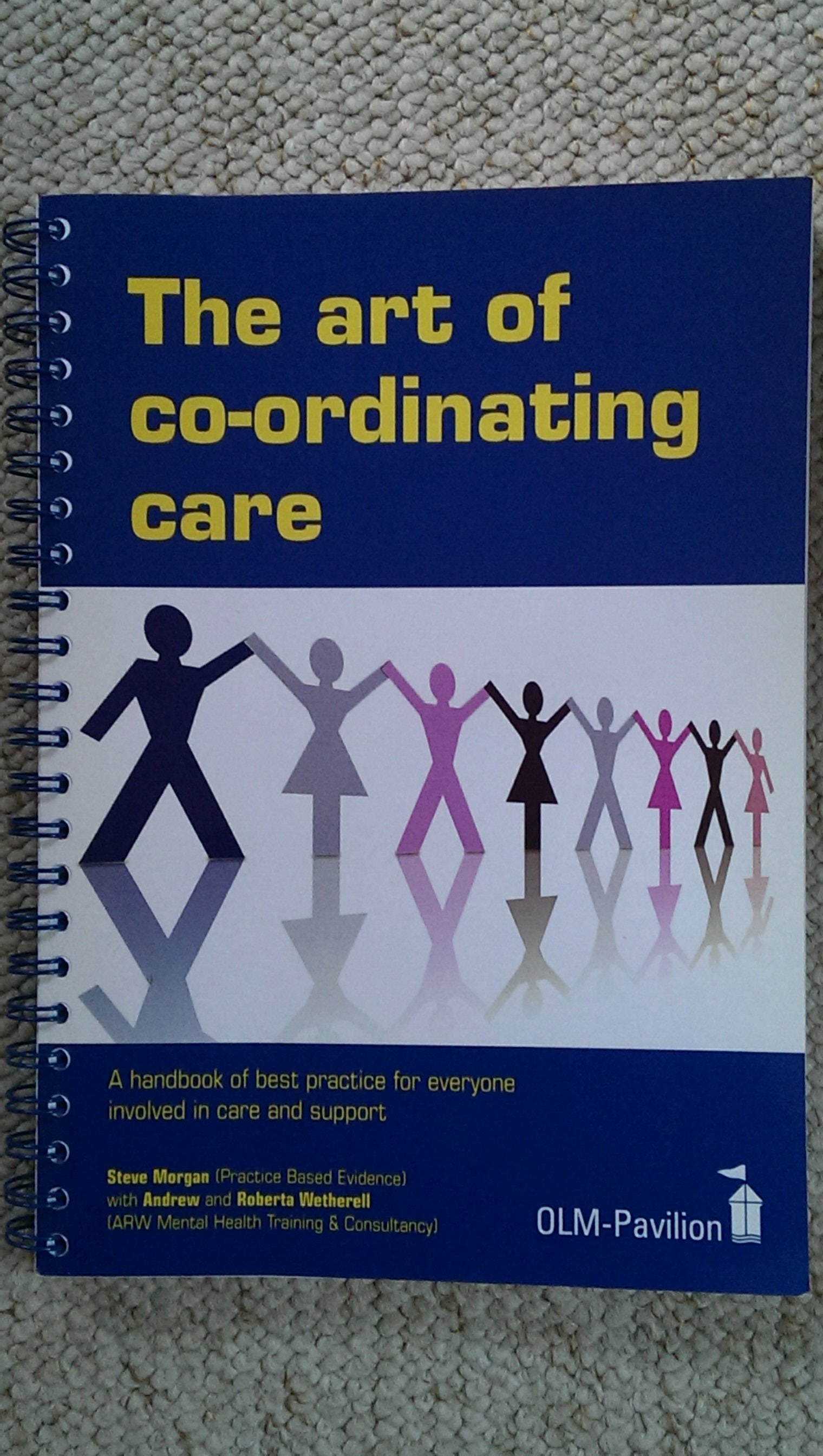
Check out my 2009 publication The Art of Co-ordinating Care, written with Andrew & Roberta Wetherell, for the best practice to achieve person-centred working and delivery of care and support.