
Tag Archives: Strengths

Assertive Outreach: Examples of Great Teams

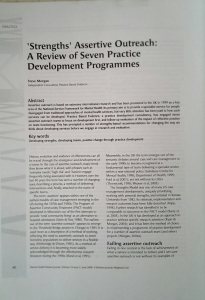
IMAG2227_1‘Strengths’ Assertive Outreach: A Review of Seven Practice Development Programmes.

The Practice Based Evidence consultancy made special efforts to get involved in going beyond simple training; focusing on developing teams with a positive impact on practice. It is one thing to claim to support best practice, but another thing entirely to provide evidence for such claims. Assertive Outreach teams in the UK were a particular passion from the original establishment of the consultancy in October 2001. The following article was first published in the Mental Health Review Journal (June 2008) and is reproduced with their kind permission; it is an evaluation of the support provided, from a strengths perspective, for seven such teams.

ABSTRACT

Assertive outreach is based on extensive international research and has been promoted in the UK in 1999 as a key area of the National Service Framework for Mental Health. Its primary aim is to provide a specialist service for people disengaged from traditional approaches of mental health services, but very little attention has been paid to how such services can be developed. Practice Based Evidence, a practice development consultancy, has engaged seven assertive outreach teams to focus on development first, and follow-up evaluation of the impact of reflective practice on team functioning. This has prompted a number of strengths-based recommendations for changing the way we think about developing services before we engage in research and evaluation.

PDF: ‘Strengths’ Assertive Outreach: A Review of Seven Practice Development Programmes

Podcast Episode 088: Great Leaders & Great Managers

TheStrengthsRevolution_albumart_2-2What qualities do we look for in our great leaders and great managers? Can one person embody both functions? The great leader connects people to a vision of a better future, and a great manager instils quality performance in other people to achieve the steps towards the ultimate goals.
In this episode I use a series of quotes from the business literature to examine the roles of a great leader and a great manager. It is for you the individual to reflect on how these quotes resonate with your own experiences of being led and managed, and of leading and managing. I also briefly reflect on some of my experiences across the last 30 years of being led and managed.

For the full content of this episode click on the links to iTunes and Sound Cloud (or go to Stitcher Radio):

https://itunes.apple.com/gb/podcast/strengths-revolution-steve/id867043694

https://itunes.apple.com/gb/podcast/088-great-leaders-great-managers/id867043694?i=358117306&mt=2

“The manager asks how and when, the leader asks what and why.” [Warren Bennis].

Podcast Episode 087: Leadership or Management?

TheStrengthsRevolution_albumart_2-2What is the distinction between leadership and management? Do we need to have more of one and less of the other? Ideally we need the good experiences of both.

In this episode I explore the future focus of leadership alongside the present focus of management. Using a series of quotes from the literature the contrast and the complimentary nature of both can emerge, and it is for each of us to reflect on how our own experiences resonate with the messages offered.

Leadership can not be learned from academic theory, it needs to be experienced, and for the experience to be refined through constructive feedback. Management should be about people more than it is about systems and processes. The primary functions of management have a place, but they should not be enabled to become the mainframe of the picture that people have to fit into. It is the strengths and creativity of people that contributes most to achievement, not the managerial tools and targets.

For the full content of this episode click on the links to iTunes and Sound Cloud (or go to Stitcher Radio):

https://itunes.apple.com/gb/podcast/strengths-revolution-steve/id867043694

https://itunes.apple.com/gb/podcast/087-leadership-or-management/id867043694?i=358117275&mt=2

“Management is doing things right; leadership is doing the right things.” [Peter Drucker].

” Most of what we call management consists of making it difficult for people to get their jobs done.” [Peter Drucker].

Podcast Episode 086: The 12 Questions

TheStrengthsRevolution_albumart_2-2Are we really developing the strengths of our staff in the workplace? I previously outlined my own Team Strengths Assessment, but in this episode I focus on the messages emerging from the Gallup organisation strengths research.

Buckingham & Coffman published First, Break All The Rules in 1999, which included 12 questions we should continually be asking ourselves to identify if we and our employers are really focused on identifying and exploiting what we do best. The questions focus on personal strengths and support and supervision in the workplace. Do you do what you do best every day? This is the key question to focus on, but whether we do or whether we don’t depends so much on having the right conditions within the workplace geared to developing us.

Too access the full content from this episode click the links to iTunes and Sound Cloud (or go to Stitcher Radio):

https://itunes.apple.com/gb/podcast/strengths-revolution-steve/id867043694

https://itunes.apple.com/gb/podcast/086-the-12-questions/id867043694?i=357225170&mt=2

“Teamwork makes a dream work, but a vision becomes a nightmare when the leader has a big dream and a bad team.” [John C. Maxwell].

Podcast Episode 085: Evidence from the business world

TheStrengthsRevolution_albumart_2-2Do we only draw on the evidence that supports our original beliefs? The strengths approach is supported by a relatively small evidence base in the healthcare world, but if we look to the business world the quantity greatly amplifies. However, quantity should never be allowed to overshadow the quality of an evidence base.

In this episode I review the critical questions that Pfeffer & Sutton present so we do not accept evidence without analysis. They also question a fundamental tenet of the strengths approach by asking just how important ‘talent’ really is to effective outcomes.

The Gallup organisation have developed an extensive database over several decades to support the efficacy of strengths-based thinking across most industries across the world. The research identifies that successful businesses share common strengths-based approaches. The Gallup literature has also identified the key messages about what the great managers know and do. Talent is a key ingredient, but how it is managed and nurtured contributes to the difference that enables greater success.

For the full content of this episode click the links to iTunes and Sound Cloud (or go to Stitcher Radio):

https://itunes.apple.com/gb/podcast/strengths-revolution-steve/id867043694

https://itunes.apple.com/gb/podcast/085-evidence-from-business/id867043694?i=357225171&mt=2

“Copy from one, it’s plagiarism; copy from two, it’s research.” [Wilson Mizner].

Podcast Episode 084: Where is the evidence?

TheStrengthsRevolution_albumart_2-2Are we just in the business of keeping academics in jobs? Best practice is the ultimate goal for delivery of any self-respecting business, but we must be confident in the evidence that underpins our beliefs in a particular way of working. A strengths approach is no different, and making best use of our personal assets and resources needs more than just a warm feeling that it is the right thing to do.

Within the research community there are conflicting views on the efficacy of working to a strengths approach. The good news is that the critics are asking for more evidence, rather than questioning the efficacy of the approach itself. Translating evidence into practice comes with its own challenges, and my adopting of ‘Practice Based Evidence’ as a business name was largely informed by a need to strike a balance that is respectful to the messages from real time experiences.

In this episode I reflect on the strengths evidence emerging largely from strengths-based case management, with additional studies in children & families, substance misuse and corrections services. Positive outcomes are reported across a wide range of measures, and ultimately the quality of evidence has to be respected above the quantity of studies (though many on the academic side of that debate may have further questions).

For the full content of this episode click the links to iTunes and Sound Cloud (or go to Stitcher Radio):

https://itunes.apple.com/gb/podcast/strengths-revolution-steve/id867043694

https://itunes.apple.com/gb/podcast/084-where-is-the-evidence/id867043694?i=357225169&mt=2

“Know yourself. Don’t accept your dog’s admiration as conclusive evidence that you are wonderful.” [Ann Landers].

Podcast Episode 083: A Staff Strengths Framework

TheStrengthsRevolution_albumart_2-2How do we help to develop and nurture our primary resource, our individual staff? The research tells us we spend too much time trying to fix their weaknesses, and not nearly enough identifying and exploiting their unique gifts and talents.

A motivated workforce is a profitable workforce, so it makes sense from the personal and business development angles to spend more time developing strengths-based resources.

In this episode I examine some of the questions and steps from strengths literature that reinforce the use of the Strengths Assessment tool outlined in the previous episode. Mike Pegg draws together a useful list of reflections on why we achieved in the past, and how we can nurture success in the future. Marcus Buckingham offers a 6-step process for helping individual’s to develop their personal strengths statements, and to exploit strengths whilst managing weaknesses.

To access the full content of this episode click on the links to iTunes & Sound Cloud (or go to Stitcher Radio):

https://itunes.apple.com/gb/podcast/strengths-revolution-steve/id867043694

https://itunes.apple.com/gb/podcast/083-staff-strengths-framework/id867043694?i=356270234&mt=2

“The idea of recognising your strengths and using them in as versatile a way as you can is cool to me.” [Frank Ocean]

Podcast Episode 082: Staff Strengths Assessments

TheStrengthsRevolution_albumart_2-2How do we develop the potential of our individual staff members? We are all individual’s with unique abilities, interests, drives and motivations; but do we really spend time identifying and nurturing these?

The Gallup organisation research suggests that the most successful leaders and businesses do, but the majority are still focused more on fixing flaws and weaknesses. A focus on developing and exploiting strengths makes good business sense, so the question is how to go about doing it.

In this episode I outline the structure and approach of the Practice Based Evidence Staff Strengths Assessment tool. Exploring values, collaborations, creativity, team working and knowledge base. This tool has been accepted as an invaluable addition (or even preferred replacement) for traditional organisational appraisal systems. If it’s staff development you genuinely want to achieve this tool will be a valuable addition to any toolkit.

For the full content of this episode click on the links to iTunes & Sound Cloud (or go to Stitcher Radio):

https://itunes.apple.com/gb/podcast/strengths-revolution-steve/id867043694

https://itunes.apple.com/gb/podcast/082-staff-strengths-assessments/id867043694?i=355718153&mt=2

“Success is achieved by developing our strengths, not by eliminating our weaknesses.” [Marilyn dos Savant]

Podcast Episode 081: How to recover our staff

TheStrengthsRevolution_albumart_2-2With all the expectations placed on providing excellent service to clients how can we truly expect staff to value others when they don’t feel valued themselves? So, the concept of a strengths assessment should apply equally to staff members as it does to their work with clients.

In this episode I explore some of the key messages from the wide-ranging Gallup organisation’s strengths research. The focus is on why we should pay more attention to developing individual potentials, and less to fixing weaknesses. I also explore those feelings we experience when we are engaged in activity that is most likely connected to our real strengths and talents.

For the full content of this episode click on the links to iTunes & Sound Cloud (or go to Stitcher Radio):

https://itunes.apple.com/gb/podcast/strengths-revolution-steve/id867043694

https://itunes.apple.com/gb/podcast/081-how-to-recover-our-staff/id867043694?i=355718154&mt=2

“If human beings are perceived as potentials rather than problems, as possessing strengths instead of weaknesses, as unlimited rather than dull and unresponsive, then they thrive and grow to their capabilities.” [Barbara Bush]. 

Podcast Episode 080: Steve Onyett RIP

IMG_2565xx-682x1024It’s 1992, I’m submitting the manuscript for the publication of my first book. Anticipation is tinged with anxiety, an anonymous reviewer holds the power to launch or terminate my fledgling writing career. All fears immediately recede as I receive pages of positive comment and constructive critique. Many references are made to a newly published book ‘Case Management in Mental Health’ (he beat me to that title by 6 months) give away the source of the review. Steve never did anonymity very well!

Fast-forward 22 years through my publications CV and I realize my latest book would benefit from an appropriate foreword from a recognized expert. They say ‘when you want something doing ask a busy person’, that should have been coined about Steve Onyett as he agreed unequivocally and produced a pitch perfect reflection of the book. Who else could get royalty and the act of farting into a mental health textbook with such skill?

In 2009, while facilitating a team development workshop, I received two of the finest compliments I have ever received. Two senior and experienced practitioners enthusiastically told me how influential my book had been on their work. As they elaborate further it becomes clear to me they are talking about ‘Teamworking’, published by Steve in 2003. As I had been acknowledged in his book I decided to unashamedly bask in the reflected glory. Being Steve Onyett for a few minutes still ranks as one of my finest moments! He loved that anecdote when I recently revealed it to him, but couldn’t help but try to reflect any glory back to me. Steve had a particular modesty when it came to appraising his own work.

In his relationship to others the word that comes to mind for me in describing Steve would be generosity. He gave of his time, but perhaps more important was the quality of that gift. Steve had a generosity of spirit that shone through his passion to understand and help people. To describe Steve by his professional role of psychologist is to miss the point; he was a humanist who believed in the potential of others and dedicated his life to supporting and developing people. His choice of the Spanish word ‘Entero’ was apt for describing his passion for the whole person, supporting people to discover or recover their own solutions, identity and true place in the world.

His conference presentations were dynamic and engaging, and his workshops were always a passionate process of exploration and discovery. Steve understood the stupidity of some of the systems we have created, but was always prepared to work within them to create better leadership and conditions for change. He infused everything he did with a big heart, but on 28th September 2015 that heart tragically failed him. I lost my greatest guide and mentor, and the world of mental health lost one of its brightest lights. To use one of his favourite words, knowing you Steve was truly ‘groovy’… rest in peace my dear friend.

For the full content of this episode click on the links for iTunes and Soundcloud (or go to Stitcher Radio):

https://itunes.apple.com/gb/podcast/strengths-revolution-steve/id867043694

https://itunes.apple.com/gb/podcast/080-steve-onyett-rip/id867043694?i=355718155&mt=2

This tribute was originally drafted for inclusion on the Centre for Mental Health website at the following link:

http://www.centreformentalhealth.org.uk/News/tribute-to-steve-onyett