
Tag Archives: management

Podcast Episode 093: A Strengths Leadership Programme

TheStrengthsRevolution_albumart_2-2How serious are we about truly developing the talent of our key people? The world is over-populated with academic pursuit of leadership initiatives, all competing to produce people with accredited qualifications. But what about developing people with the confidence to deliver on the practical day-to-day challenges that our businesses through at people?

In this episode I outline my specifically created Strengths Leadership Programme for the key staff members… our team leaders & team managers. Based in the Gallup research and literature it focuses on identifying talent, developing strengths, and applying this knowledge to personal and team development in the practices that team leaders work in every day. It offers a 4-day workshop introduction, but is focused more on local impact of knowledge through supervised and supported practice over a year, and the nurturing of specific peer group support. If you’re looking for another certificate to hang on the wall go somewhere else.

For the full content of this episode click the links to iTunes and Sound Cloud (or go to Stitcher Radio):

https://itunes.apple.com/gb/podcast/strengths-revolution-steve/id867043694

https://itunes.apple.com/gb/podcast/093-strengths-leadership-programme/id867043694?i=360203263&mt=2

“If you spend your life trying to be good at everything, you will never be great at anything.” [Tom Rath].

“Our chief want is someone who will inspire us to be what we know we could be.” [Ralph Waldo Emerson].
Podcast Episode 092: Using StrengthsFinder

TheStrengthsRevolution_albumart_2-2How do you go about identifying your natural talents? Most of us stroll through life largely oblivious to what we may excel at. Either we are subject to the constant focus on our weaknesses, and attempting to get them fixed, in the flawed assumption that this helps us to massively improve our performance. Or, we are simply just not aware of resources that can focus attention more on the task of identifying the talents and developing our true strengths.

The Gallup organisation has not just researched this area for several decades, but also mined the massive database to inform and develop the tools for strengths development. In this episode I reflect on this process of identifying talents and developing strengths. I use my own results from taking the StrengthsFinder test (on two separate occasions) to illustrate the process and themes of talent that have emerged out of the Gallup work.

For the full content of this episode click on the links to iTunes and Sound Cloud (or go to Stitcher Radio):

https://itunes.apple.com/gb/podcast/strengths-revolution-steve/id867043694

https://itunes.apple.com/gb/podcast/092-using-strengthsfinder/id867043694?i=360203264&mt=2

“The key to human development is building on who you already are.” [Tom Rath]

Podcast Episode 091: Positive Risk-Taking in practice

TheStrengthsRevolution_albumart_2-2It’s one thing to have a great idea but another entirely to put it successfully into practice, particularly if it is about delivering on difficult and challenging decisions. What does it take to put positive risk-taking into practice with clarity and confidence?

This was a concept I developed in 1994 and have been refining and implementing with so many people in the intervening years. Everyone wants to feel like they do good risk-taking practice, but when examined closely there are a plethora of obstacles to be overcome in the process.

In this episode I outline a list of 14 essential ingredients for putting positive risk-taking into practice. A combination of shared understanding by individuals, teams and organisation management is a good starting point; but that is often difficult enough to achieve. I outline the value of strengths-based practice for underpinning good risk-taking decisions, as well as consensus in teams, adequate training, supervision and support, and the application of checklists and tools I designed specifically for the purpose.

For the full content of this episode click on the links to iTunes and Sound Cloud (or go to Stitcher Radio):

https://itunes.apple.com/gb/podcast/strengths-revolution-steve/id867043694

https://itunes.apple.com/gb/podcast/091-positive-risk-taking-in/id867043694?i=359052989&mt=2

“If you do what you’ve always done, you’ll get what you’ve always gotten.” [Tony Robbins].

“Life is inherently risky. There is only one big risk you should avoid at all costs, and that is the risk of doing nothing.” [Denis Waitley].

Podcast Episode 090: Implementing great work

TheStrengthsRevolution_albumart_2-2A good idea is about 10 percent of the effort, it’s the implementation and hard work that makes up the bulk of the effort. But how do we go about identifying and implementing good ideas? What can we use to help us deliver great work?

In the case of a Strengths Approach and Positive Risk-Taking, two of my signature ways of working, I have developed specific practice development tools to help not just identify the ideas but just as importantly put them into practice.

In this episode I outline the Practice Based Evidence evaluation and implementation tools I use in my team development work to put these two particular concepts into practice. These are practice-based tools to be owned and used by frontline staff and teams; these are definitely not managerial tools with a top-down need to audit. There comes a moment when you need to stop revving up the car and shove it into gear (David Maloney), and these tools are part of the gear mechanism not the braking system!

For the full content of this episode click on the links to iTunes and Sound Cloud (or go to Stitcher Radio):

https://itunes.apple.com/gb/podcast/strengths-revolution-steve/id867043694

https://itunes.apple.com/gb/podcast/090-implementing-great-work/id867043694?i=359052990&mt=2

“When you translate a dream into reality, it’s never a full implementation. It is easier to dream than to do.” [Shai Agassi].

“Success seems to be connected with action. Successful people keep moving. They make mistakes, but they don’t quit.” [Conrad Hilton].

Podcast Episode 089: Leading or Managing Change

TheStrengthsRevolution_albumart_2-2Why do we need to be constantly changing things? Is there too much change going on in the world? It is tempting to look back with rose-tinted glasses for the better times, and to bemoan the worst of what is going on at present.

But change has undeniably contributed more positive than negative outcomes for most people. However, in business how can we best manage the process of change in order to achieve the forward momentum that brings positive gains? Prefer & Sutton remind us that a google search elicits much more interest in strategy than in implementation; so we are far more likely to want to engage in talking about change than actually doing it.

In this episode I recount the 8 key ingredients that Pfeffer & Sutton identify for increasing the odds of making the right kind of change. Listening to people is the most significant factor. I also outline the four forces they suggest are needed to create the environment for change to take place. Change is a fact, it is happening all of the time, so lets get it right.

For the full content of this episode click the links to iTunes and Sound Cloud (or go to Stitcher Radio):

https://itunes.apple.com/gb/podcast/strengths-revolution-steve/id867043694

https://itunes.apple.com/gb/podcast/089-leading-or-managing-change/id867043694?i=358569524&mt=2

“Hearing true things is more important than saying smart things… you need to ask good questions before you can come up with smart answers.” [Pfeffer & Sutton].

Assertive Outreach: Examples of Great Teams

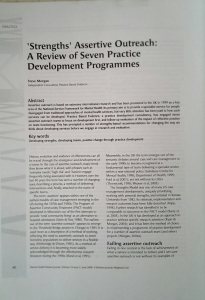
IMAG2227_1‘Strengths’ Assertive Outreach: A Review of Seven Practice Development Programmes.
The Practice Based Evidence consultancy made special efforts to get involved in going beyond simple training; focusing on developing teams with a positive impact on practice. It is one thing to claim to support best practice, but another thing entirely to provide evidence for such claims. Assertive Outreach teams in the UK were a particular passion from the original establishment of the consultancy in October 2001. The following article was first published in the Mental Health Review Journal (June 2008) and is reproduced with their kind permission; it is an evaluation of the support provided, from a strengths perspective, for seven such teams.

ABSTRACT

Assertive outreach is based on extensive international research and has been promoted in the UK in 1999 as a key area of the National Service Framework for Mental Health. Its primary aim is to provide a specialist service for people disengaged from traditional approaches of mental health services, but very little attention has been paid to how such services can be developed. Practice Based Evidence, a practice development consultancy, has engaged seven assertive outreach teams to focus on development first, and follow-up evaluation of the impact of reflective practice on team functioning. This has prompted a number of strengths-based recommendations for changing the way we think about developing services before we engage in research and evaluation.

PDF: ‘Strengths’ Assertive Outreach: A Review of Seven Practice Development Programmes

Podcast Episode 088: Great Leaders & Great Managers

TheStrengthsRevolution_albumart_2-2What qualities do we look for in our great leaders and great managers? Can one person embody both functions? The great leader connects people to a vision of a better future, and a great manager instils quality performance in other people to achieve the steps towards the ultimate goals.

In this episode I use a series of quotes from the business literature to examine the roles of a great leader and a great manager. It is for you the individual to reflect on how these quotes resonate with your own experiences of being led and managed, and of leading and managing. I also briefly reflect on some of my experiences across the last 30 years of being led and managed.

For the full content of this episode click on the links to iTunes and Sound Cloud (or go to Stitcher Radio):

https://itunes.apple.com/gb/podcast/strengths-revolution-steve/id867043694

https://itunes.apple.com/gb/podcast/088-great-leaders-great-managers/id867043694?i=358117306&mt=2

“The manager asks how and when, the leader asks what and why.” [Warren Bennis].

Podcast Episode 087: Leadership or Management?

TheStrengthsRevolution_albumart_2-2What is the distinction between leadership and management? Do we need to have more of one and less of the other? Ideally we need the good experiences of both.

In this episode I explore the future focus of leadership alongside the present focus of management. Using a series of quotes from the literature the contrast and the complimentary nature of both can emerge, and it is for each of us to reflect on how our own experiences resonate with the messages offered.

Leadership can not be learned from academic theory, it needs to be experienced, and for the experience to be refined through constructive feedback. Management should be about people more than it is about systems and processes. The primary functions of management have a place, but they should not be enabled to become the mainframe of the picture that people have to fit into. It is the strengths and creativity of people that contributes most to achievement, not the managerial tools and targets.

For the full content of this episode click on the links to iTunes and Sound Cloud (or go to Stitcher Radio):

https://itunes.apple.com/gb/podcast/strengths-revolution-steve/id867043694

https://itunes.apple.com/gb/podcast/087-leadership-or-management/id867043694?i=358117275&mt=2

“Management is doing things right; leadership is doing the right things.” [Peter Drucker].

” Most of what we call management consists of making it difficult for people to get their jobs done.” [Peter Drucker].

Risk and Leadership

Updated Risk Resource (2013)

What role does leadership play in good practice regarding how we work with risk? Leadership is often lacking, and management is all too often to the fore where considerations of risk are concerned in health and social care agencies. In this scenario fear and back-covering hold the attention, while good practice is presented as an unconvincing façade. Managers strangely play down any questions about excessive bureaucracy while still demanding all the paperwork is completed as the primary target. If something goes wrong it is the paperwork that gets sole attention, and real practice considerations are relegated to a place somewhere to the right of obscurity.

‘Good paperwork is a sign of good practice’ becomes the convenient smokescreen. This would be true if there was less management and more supportive leadership, as the need for paperwork would be put into perspective: as the essential minimum to support good practice not to hinder it. Good tools are a range of checklists and formats that have been shaped by good practice, and thus they are able to guide and prompt firstly, and capture good practice as a secondary function.

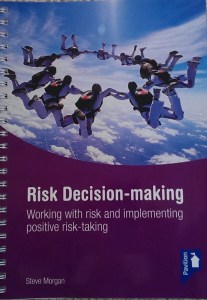
The Risk Decision-Making publication is the update of 17 years of working with individual practitioners and teams across countless organisations, both from within the Sainsbury Centre for Mental Health initially and through the Practice Based Evidence consultancy since 2001. The tools and guidance are informed by what we know from the national and international research, but more significantly through the practice based evidence of hundreds of practitioners across all disciplines and service sectors. Most importantly, this publication refocuses the attention on risk as everyone’s business; so it is structured throughout to address issues from the perspective of individual’s, teams and the leadership & management of organisations. Whatever systems your leaders have bought or put into place there is still a role for guidance on best practice, so look no further.

Podcast Episode 086: The 12 Questions

TheStrengthsRevolution_albumart_2-2Are we really developing the strengths of our staff in the workplace? I previously outlined my own Team Strengths Assessment, but in this episode I focus on the messages emerging from the Gallup organisation strengths research.

Buckingham & Coffman published First, Break All The Rules in 1999, which included 12 questions we should continually be asking ourselves to identify if we and our employers are really focused on identifying and exploiting what we do best. The questions focus on personal strengths and support and supervision in the workplace. Do you do what you do best every day? This is the key question to focus on, but whether we do or whether we don’t depends so much on having the right conditions within the workplace geared to developing us.

Too access the full content from this episode click the links to iTunes and Sound Cloud (or go to Stitcher Radio):

https://itunes.apple.com/gb/podcast/strengths-revolution-steve/id867043694

https://itunes.apple.com/gb/podcast/086-the-12-questions/id867043694?i=357225170&mt=2

“Teamwork makes a dream work, but a vision becomes a nightmare when the leader has a big dream and a bad team.” [John C. Maxwell].