
Tag Archives: Personal development

Podcast Episode 077: What is recovery?

TheStrengthsRevolution_albumart_2-2‘Recovery’ can simply be described as to regain, get back or restore something which has been lost, but in health and social care services we don’t tend to go for the simple and straight forward, particularly when confused and complicated are on offer.

I fully support the concept of recovery, as it was originally identified by service users, but I despair at how easily those in power feel able to misappropriate good ideas to dress up their otherwise complex demands. Now I tend to see recovery as something designed by service users, hijacked by commissioners, managers and politicians, and crashed by practitioners.

In this episode I explore how a uniquely personal and individual concept of great merit and purpose has become subsumed into the corporate world of strategic direction, and subsequently lost in translation. The original pioneers foretold in warnings of how the concept will lose its power when it becomes systematised, but the world of bureaucracy is not known for heeding warnings, particularly if they don’t appeal to the perpetual need to homogenise the individual experience.

For the full content of this episode click on the links to iTunes and Sound Cloud (or go to Stitcher Radio):

https://itunes.apple.com/gb/podcast/strengths-revolution-steve/id867043694

https://itunes.apple.com/gb/podcast/077-what-is-recovery/id867043694?i=353576160&mt=2

“You can get the monkey off your back, but the circus never leaves town.” [Anne Lamott].
Podcast Episode 076: What is solution focused therapy?

TheStrengthsRevolution_albumart_2-2Solution Focused Therapy has been established in the US since the early 1970’s, but didn’t make an impact in Europe until the mid to late 1980’s.

The approach is largely attributed to Steve de Shazer, and has garnered considerable favour with the attibution of ‘Brief’ in front of its title. Many clients and practitioners alike favour the specific focus on finding solutions through brief interactions and short term interventions. In my work presenting a strengths approach I have often encountered practitioners asking ‘isn’t this a bit like Brief Solution Focused Therapy?’

In this episode I examine the strengths credentials of this approach, with reference to its underlying core principles, the therapeutic roles of clients and practitioners, and its therapeutic approach underpinned by specific lines of inquiry. Discover the secrets of the ‘miracle question’.

For the full content of this episode click the links for iTunes and Sound Cloud (or go to Stitcher Radio):

https://itunes.apple.com/gb/podcast/strengths-revolution-steve/id867043694

https://itunes.apple.com/gb/podcast/076-what-is-solution-focused/id867043694?i=352344729&mt=2

“Every great and deep difficulty bears in itself its own solution. It forces us to change our thinking in order to find it.” [Niels Bohr].

Podcast Episode 072: Provocative Propositions

TheStrengthsRevolution_albumart_2-2The strengths approach shares many values, principles and practices with other well known approaches, one of which is Appreciative Inquiry.

During a conversation planning for a workshop presentation at a conference the question of establishing a ‘provocative proposition’ arose… a concept closely integrated into the practice of Appreciative Inquiry.

In this episode I establish my statement as: ‘Positive risk-taking will transform the relationship of individuals and organisations to risk forever!’ I then test out this statement against the eight criteria for a good provocative proposition. See whether you agree, and more importantly, learn a little more about how positive risk-taking should be implemented to maximum effect.

For the full content of this episode click on the links to iTunes and Sound Cloud (or go to Stitcher Radio):

https://itunes.apple.com/gb/podcast/strengths-revolution-steve/id867043694

https://itunes.apple.com/gb/podcast/072-provocative-propositions/id867043694?i=350141736&mt=2

“When someone sets out to be controversial or provocative or shocking as an end in itself, I don’t think that’s a noble goal.” [Rob Bell].

Podcast Episode 071: Sarah’s Story

TheStrengthsRevolution_albumart_2-2Person centred planning is a concept well established in learning disability services, with a clear set of principles, broad questions, tools and methods for capturing plans. But, what does it really look like in practice?

In this episode I narrate a detailed case example from a service I had been involved in developing. This case study of Sarah (not her real name) highlights not just the challenges of diagnosed multiple conditions, but also the barriers that have to be overcome in getting your close sources of support to change in order to achieve your desired wishes. Some of Sarah’s presentation is undoubtedly challenging, but this episode explains how they have been accommodated and overcome with creative thinking, as well as illustrating the process happening in practice.

For the full content of this episode click on the links to iTunes and Sound Cloud (or go to Stitcher Radio):

https://itunes.apple.com/gb/podcast/strengths-revolution-steve/id867043694

https://itunes.apple.com/gb/podcast/071-sarahs-story/id867043694?i=350141737&mt=2

“I was diagnosed with a severe temporal spatial deficit, a learning disability that means I have zero spatial relations skills. It was official: I was a genius trapped in an idiot’s body.” [Sloane Crosley].

Podcast Episode 062: Problems with Meetings

TheStrengthsRevolution_albumart_2-2How effective are all of the meetings you attend? It’s very likely that whatever business you are working in you will have to attend meetings either occasionally or frequently. They take up an inordinate amount of time, but the question is just how much time are they wasting?

In this episode I will take a formal definition of meetings, but add my twist with several reflections on how I have experienced meetings on occasions. Hot-air, self-importance, shared insecurities, ineffective time-wasting… but enough of me!

How can we attempt to make this precious time as effective and engaging as possible? I set out seven pointers that can help achieve these goals in ways that either reflect the good practice you are already doing, or will transform the experience of all who need to be attending.

For the full content of this episode click on iTunes and Sound Cloud (or go to Stitcher Radio):

https://itunes.apple.com/gb/podcast/strengths-revolution-steve/id867043694

https://itunes.apple.com/gb/podcast/062-problems-with-meetings/id867043694?i=344569093&mt=2

“Meetings are indispensable when you don’t want to do anything.” [J.K. Galbraith].

The Art of Co-ordinating Care

Person-centred (2009)

Care co-ordination, the role of the care co-ordinator, has become a challenging function of our care and support services, attracting more than its fair share of negative connotations. A genuine tension exists between the passion and artfulness of human relationships on the one hand, and the pursuit of a scientific basis for interventions on the other. The science of research seeks to impose a sense of reassurance by means of consistent results when defined sets of circumstances are observed or applied.

By contrast, the quality of an artful endeavour may be measured more by its emotional characteristics and the feelings it engenders in those involved or observing. In reality, the experience and practice of mental health and learning disability services is primarily a study of people’s emotional experiences, feelings and behaviour patterns. So we should be wary of any attempts to understate the elements of artfulness and passion; and we should recognise the potential impact this may have on our enjoyment of the work, as well as our motivation for doing it.

Arguably, one of the most crucial effects of the evidence-based practice focus of research is that it undermines the art of relationship-building. The pursuit of a rigorous scientific rationale places a clear priority on the cult of numbers. ‘How many?’ and ‘How frequently?’ and ‘How quickly?’ become the valued quantitative outcomes of an efficient service. But what is the cost of this, in terms of an effective, good quality experience for the individual service user within this wider research picture? Or, indeed, what is the cost of its impact on the qualitative experience of the work that, for many practitioners, is their motivation? Ideally, we need to strike a careful balance between art and science in the delivery of good quality care and support.

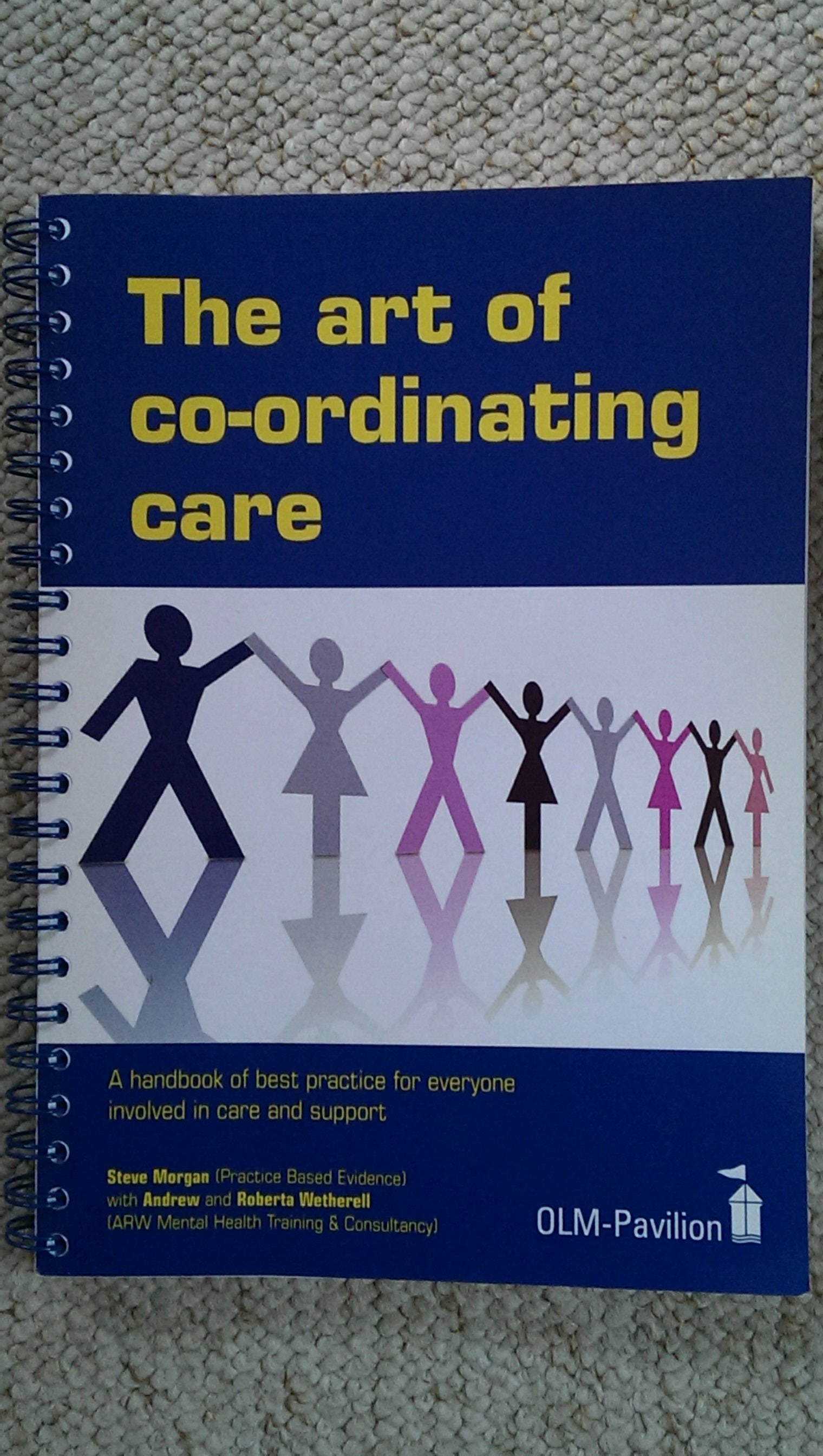
Check out my 2009 publication The Art of Co-ordinating Care, written with Andrew & Roberta Wetherell, for the best practice to achieve person-centred working and delivery of care and support.

Podcast Episode 061: Constructing Strengths Assessments [3]

TheStrengthsRevolution_albumart_2-2Building up a strengths assessment based on personal reflection, or helping others to construct a picture requires a positive outlook and a determination to enquire into what has worked in the past, what is working at present, and what is wanted in the future.

Alongside the picture of who we are, we should concentrate on building the picture of what we have and what we want. In the practical but essential components of shelter, finances and relationships, it is important to reflect on what works for each of us, and why it works? In terms of housing, where we live can be equally as important as what type of accommodation we prefer to live in.

In this episode I explore the questions that help us to dig for the detail around home, work, relationships, leisure, daily living, and spiritual reflections.

For the full content of this episode click on the links to iTunes and Sound Cloud (or go to Stitcher Radio):

https://itunes.apple.com/gb/podcast/strengths-revolution-steve/id867043694

https://itunes.apple.com/gb/podcast/061-constructing-strengths/id867043694?i=343344278&mt=2

“Being deeply loved by somebody gives you strength, while loving someone deeply gives you courage.” [Lao Tzu].

Podcast Episode 060: Constructing Strengths Assessments [2]

TheStrengthsRevolution_albumart_2-2Building up a strengths assessment based on personal reflection, or helping others to construct a picture, requires a positive outlook and a determination to enquire into what has worked in the past, what is working at present, and what is wanted in the future. It is about developing an inventory of resources that can then be productively applied to achieving desired future priorities and/or managing life’s difficulties and challenges with greater skill and confidence.

It should start from some of the big open-ended questions about who we are, and what we like about ourselves, and what we want for the future. With this standpoint in mind, a reflection on personality traits and personal qualities helps to focus attention more on the question of who we are.

In this episode I briefly explore some of the personality traits and qualities that help to define us, and how we might identify them in ourselves or others. Issues of health are also explored alongside these traits.

For the full content of this episode click on the links to iTunes and Sound Cloud (or go to Stitcher Radio):

https://itunes.apple.com/gb/podcast/strengths-revolution-steve/id867043694

https://itunes.apple.com/gb/podcast/060-constructing-strengths/id867043694?i=343344279&mt=2

“Always be yourself, express yourself, have faith in yourself, do not go out and look for a successful personality and duplicate it.” [Bruce Lee].

Podcast Episode 059: Constructing Strengths Assessments

TheStrengthsRevolution_albumart_2-2How do we go about constructing a strengths assessment? Whether it be reflecting on our selves or working with other people, it is a flexible process developed over time, not a function to be mandated, timed and audited by a managerial approach.

For ourselves, it happens as and when we give ourselves time for reflection. With others, it is best achieved through an informal, conversational approach where the other person feels most comfortable; or it emerges from snippets of conversations over a period of time.

The focus is to build a positive picture, that can then be applied to achieving the goals we set for ourselves, or others set for themselves. It can be prompted and supported by paper or electronic forms, but they are purely supportive tools not the end purpose.

It can be developed by and within teams, but the key is always to be engaging the fullest involvement of the specific person who is the subject of the strengths assessment. In this episode I outline the five main areas of consideration for developing the practice of constructing a strengths assessment.

For the full content of this episode click on the links to iTunes and Sound Cloud (or go to Stitcher Radio):

https://itunes.apple.com/gb/podcast/strengths-revolution-steve/id867043694

https://itunes.apple.com/gb/podcast/059-constructing-strengths/id867043694?i=343344280&mt=2

“Over the years I’ve learned that a confident person doesn’t concentrate or focus on their weaknesses, they maximise their strengths.” [Joyce Meyer].

Podcast Episode 058: Working with Strengths Checklist

Working-with-StrengthsHow do we go about building a picture of our strengths, and those of others? We don’t usually greet each other by enquiring what we are no good at, or what we have recently screwed up; yet we also do not naturally and consistently search deeply for those inner-most strengths and natural talents.

Listen to any conversation between people who have met for the first time, at a conference for example, and they explore what defines each other in a the positive sense of ‘what do you do?’ or ‘what are your specific interests in the subject of the conference?’ We should never make the big decisions based on the negative of weaknesses, we should build it on the drives and motivations, the dreams and aspirations.

In this episode I outline an 8-point checklist as prompts for building up a picture of our strengths. These are our resources, from within us and around us, so we should be devoting more time to identifying them and making best use of them. Ultimately it is our strengths that best equip us to manage our problems and weaknesses. Off the top of your head what would you identify as your best qualities and strengths? Then keep adding to that initial picture over time.

Fir the full content of this episode click on the links to iTunes and Sound Cloud (or go to Stitcher Radio):

https://itunes.apple.com/gb/podcast/strengths-revolution-steve/id867043694

https://itunes.apple.com/gb/podcast/058-working-strengths-checklist/id867043694?i=341592555&mt=2

“Strength and growth come only through continuous effort and struggle.” [Napoleon Hill].